Most Meta ads advice is written for budgets ten times bigger. With $10 to $30 a day, or less than $1,000 a month, that same advice can quietly work against you.
I think of a small budget as a small kitchen. You cannot serve a forty-dish menu from one stove. You pick a few dishes, buy good ingredients and cook each one properly. This post shows what that looks like in Meta ads, whether you are after leads, messages or shopping sales.
If you want the bigger picture first, read what I do in the first 90 days with a new brand. The budget was one paragraph there. Here it gets its own post.
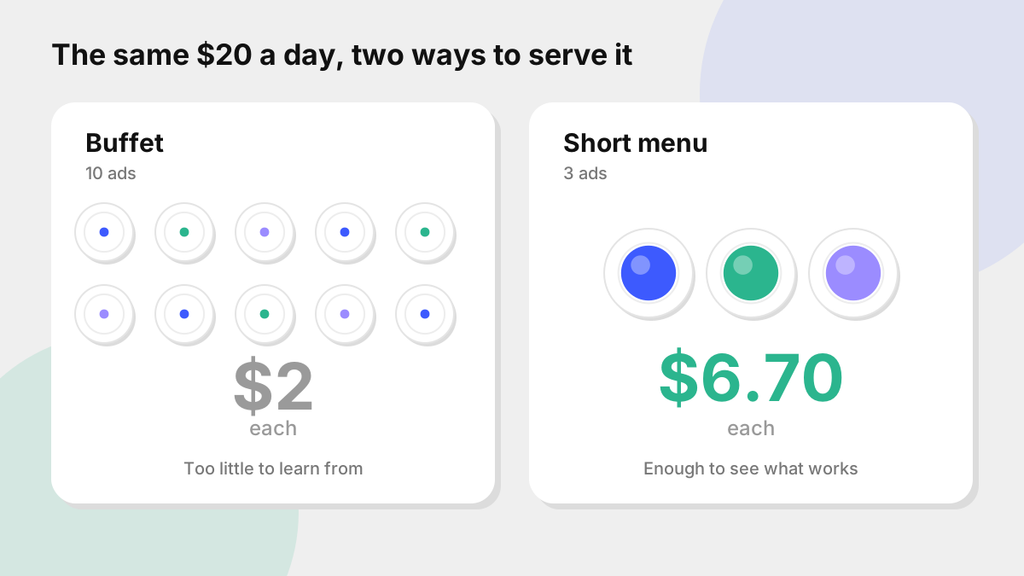
Short menu: fewer ads, more money on each
Every extra campaign, ad set and ad takes a slice of the same budget. Split $20 a day across ten ads and each one gets about $2. None of them collects enough results to tell you anything, and Meta has very little to learn from.
On a small budget I keep the structure plain: one campaign, one ad set, and two to five ads that are genuinely different from each other. One goal at a time. I also skip the separate test campaign. It pulls money away from the campaign that needs it, and a test with that little spend often gives a misleading answer. Testing happens inside the main campaign.
Kitchen capacity: how much budget Meta needs to learn
Meta’s delivery system learns from results. It needs enough of them in a short period before delivery settles. A commonly quoted rough guide is around 50 results a week per ad set, and the real number varies with the account, the offer and the market. A result is whatever you optimize for: a lead, a message, a purchase. If you get only a handful a week, costs keep jumping around.
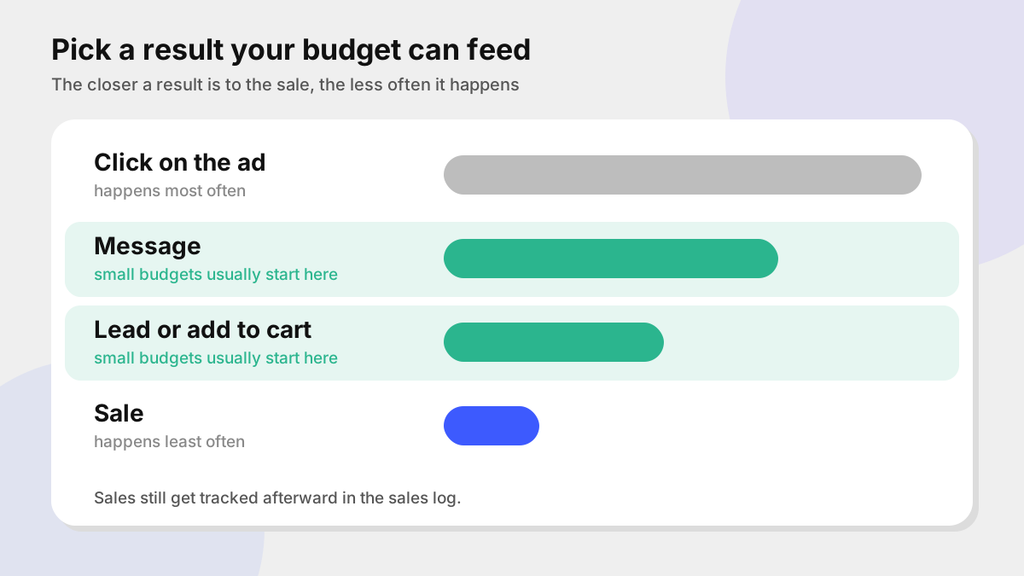
This is where budget and goal meet. The closer a result sits to the sale, the less often it happens and the more each one costs. A small budget can feed frequent results such as messages, leads or add to cart, and it struggles to feed purchases. What counts as frequent changes with the sector, the price and the offer, so I look at my own cost per result and ask whether the budget can buy enough of them each week.
So I choose the closest result that happens often enough: a message, a lead form, or add to cart for a shop. Sales get tracked afterward in the sales log. That step matters, because the cheaper result is not always the better one. In my 90-day post, the cheaper message turned out to be the more expensive sale.
The menu that was too long
I learned this the slow way. For one product category I had a daily budget of $20 at most. I wanted to test several creatives, so I opened more than two separate campaigns, each with its own ads. On paper it looked organized.
In practice the money was spread so thin that some creatives never got real spend. I could not tell which ads worked, because most of them never had a fair chance to show. Finding the winners took far longer than it should have. Once I had them, scaling was slow too. Each campaign had to learn before it reached full speed, and with so little budget in each one I could not raise spend in small steps.
Today I would put the same creatives into one campaign and let Meta decide where the spend goes, then replace the ads that get no delivery. The same $20 would have told me more, much faster.
Fresh ingredients: content that works
With few ads, each one has to carry weight. For me good content is content that works and stays honest. The audience likes it, and so does the platform.
Take a service that costs $39 a month. Showing “$39” with “a month” in smaller type is fine. Showing only “$39” and revealing the monthly part after the click is a trick, and people notice. A misleading offer may raise clicks for a week. After that, viewers stop trusting you, and the platform has little patience for ads that mislead.
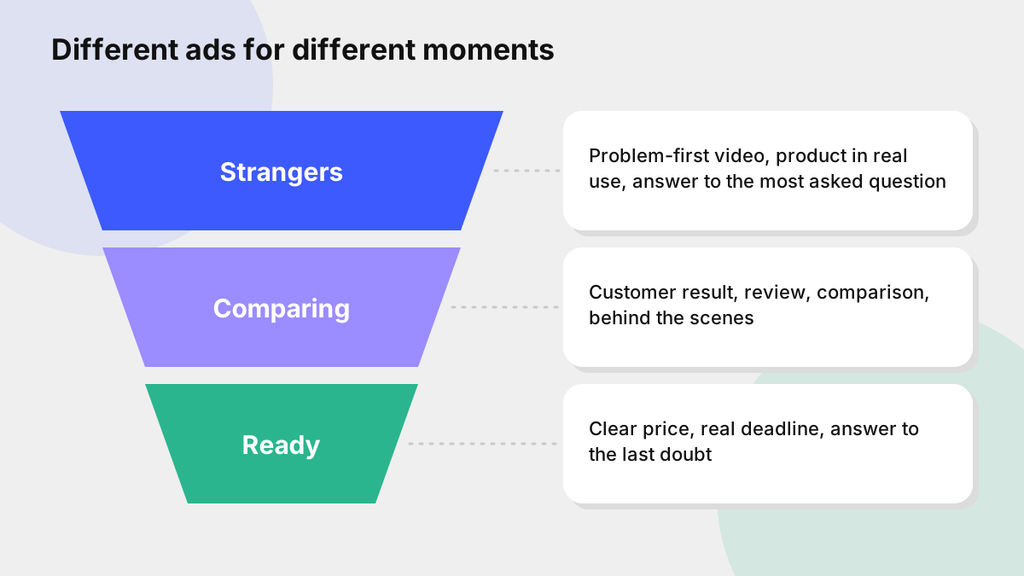
Variety matters more than volume. Meta’s delivery system appears to group very similar ads together, so ten small edits of one picture work like a single ad. Use different ideas instead, and match them to where the person is in the funnel.
At the top of the funnel, people do not know you yet. A short video that opens with their problem works well, and so does someone using the product in real life, or a quick answer to the question buyers ask most.
In the middle they are comparing. A real customer result, a review, a comparison with the usual alternative or a look behind the scenes of how the work is done give them something to trust.
At the bottom they are ready and need one last push. A clear offer with the full price visible, a real deadline, or an ad that answers the final doubt does the job.
Let it cook: scale slowly, refresh on schedule
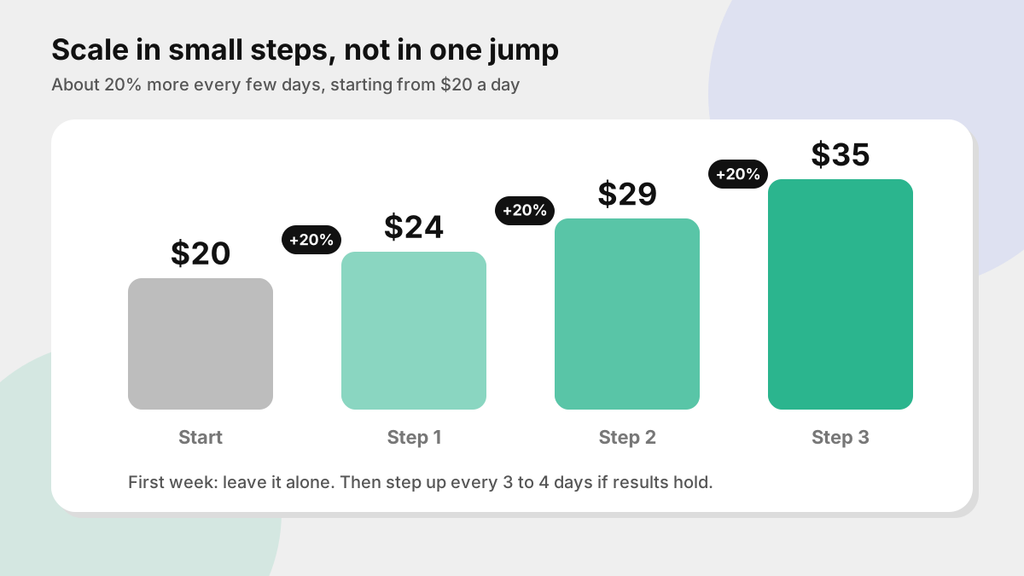
During the first week I leave the campaign alone. Changing the budget, the audience or the result you optimize for restarts learning, and a restart costs a lot when you spend $20 a day. Swapping one or two ads is fine.
When results arrive steadily, I raise the budget by about 10 to 20 percent every few days, never in one jump. On $20 a day that is $2 to $4 a step. It feels slow, and it keeps the campaign stable.
Ads also wear out. Watch frequency, the average number of times one person sees your ad in a week. When it climbs past about 3 and clicks start to fall, bring in a fresh creative. On a small budget I plan a refresh every two to four weeks.
A note on Google
How much to give Google and how much to give Meta changes from sector to sector. Search works when people already look for what you sell, and Meta works when you need to create interest first. This post covers only Meta.
The short version
- One campaign, one ad set, two to five ads that differ from each other.
- Optimize for a result your budget can buy often enough: messages, leads or add to cart before sales.
- Test inside the main campaign, not next to it.
- Keep content that works and tells the truth.
- Leave it alone for a week, then scale in small steps and refresh creatives every few weeks.
Leave a Reply